
BH
Entering Egypt to Extract Holiness
Parshat VaEra opens the active stage of the redemption from Egypt, but before we can understand the plagues themselves, we must first understand why the Jewish people were sent into Egypt at all. Egypt was not merely a place of exile or punishment. It was the central location where holiness had become trapped and embedded deep within the forces of impurity.
The Arizal explains that Egypt, at that time, was the global center of sorcery and magic. These practices draw their nourishment from holiness that has fallen into the domain of evil. The deeper and more entrenched the impurity, the more holiness must be trapped there to sustain it. Egypt therefore contained an enormous concentration of fallen sparks, making it the primary location where rectification had to take place.
The Jewish people were sent into Egypt to extract this holiness. The bondage, suffering, and purging of exile were not ends in themselves but the means by which the sparks could be elevated and removed. When the Jews ultimately left Egypt, they emptied it completely of holiness, leaving it spiritually desolate—“like a body of water without any fish,” as Rashi describes.
The Roots of Exile Before Creation
This extraction was not only repairing damage from later generations. The Arizal teaches that a major source of the holiness trapped in Egypt originated from Adam HaRishon’s 130 years of separation from Chavah, during which sparks fell into impurity. Those sparks descended specifically into Egypt, making it the place where rectification had to occur.
The descent into Egypt was therefore part of a much earlier and broader cosmic process tied to the shattering of the vessels and the earliest spiritual fractures in creation. The Jewish people, through their exile and eventual redemption, were tasked with repairing this damage.
Simcha as the Power of Extraction
In Likutey Moharan lesson 24 Rebbe Nachman reveals a fundamental principle: holiness is extracted through simcha. Joy is not merely an emotional state; it is an active spiritual force capable of breaking through impurity and reclaiming what has been lost.
This is why Rebbe Nachman links simcha to the ketoret. The ketoret has the power to penetrate deeply into the domain of evil, extract holiness, and weaken impurity. The verse in Mishlei states that ketoret brings joy to the heart, meaning that it generates joy in the Shechinah by accomplishing this extraction.
The ketoret consisted of eleven fragrances. Ten correspond to the ten sefirot of holiness, while the eleventh represents the channel through which impurity draws its nourishment. By including all eleven, the ketoret was able to descend fully into the domain of evil and pull holiness back upward. Rebbe Nachman teaches that simcha performs the same function. When a person feels stuck, trapped, or spiritually confined, joy is the mechanism that enables release.
This is why the verse in Isaiah says, “With joy you will go out.” Simcha is the method of redemption, both nationally and personally.
The Staff as the Root of Redemption
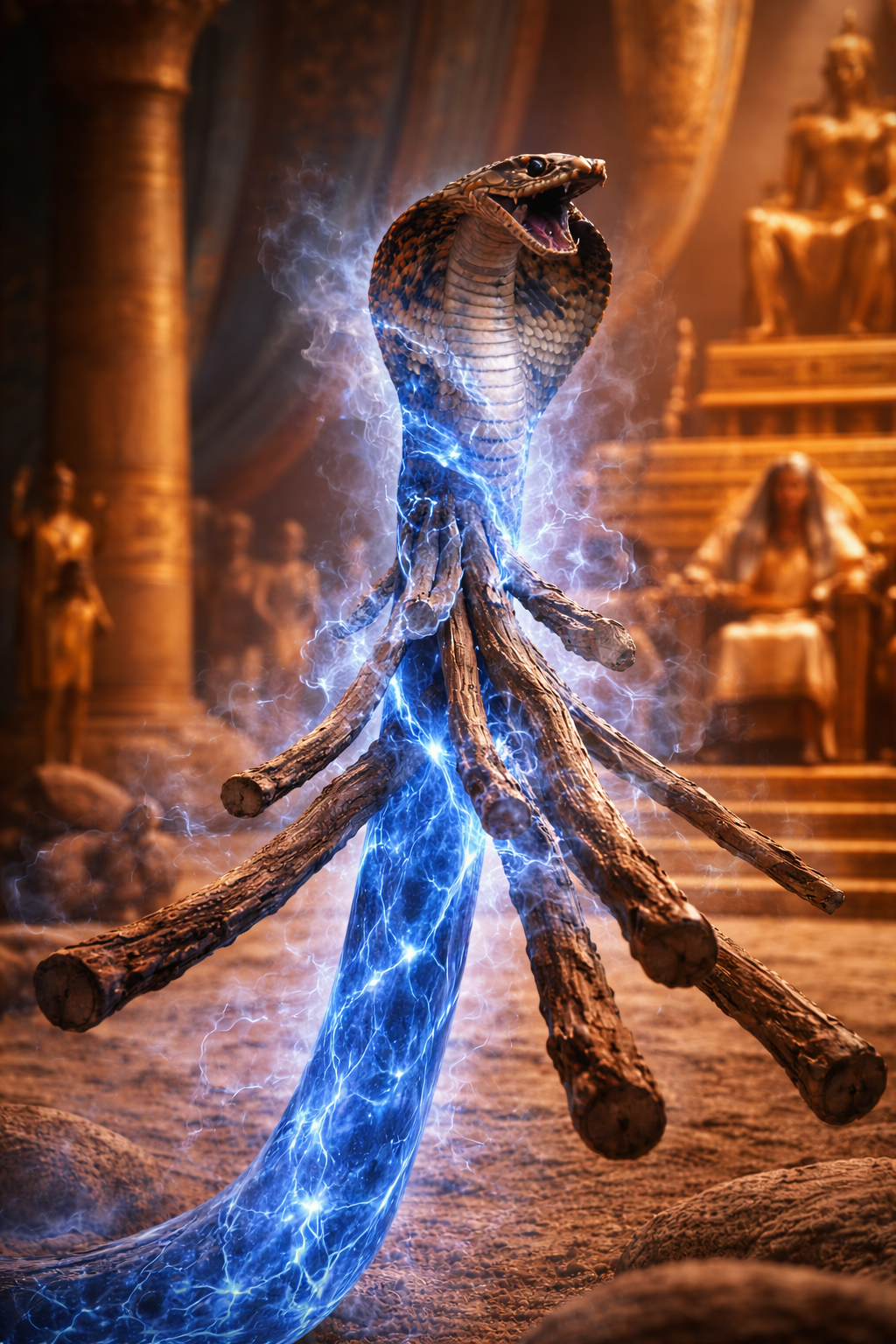
With this foundation, we can understand why Moshe’s confrontation with Pharaoh begins not with a plague, but with a sign. Before the ten plagues, Aharon throws down Moshe’s staff and it turns into a snake. This act corresponds to the number eleven—the stage before the ten plagues begin.
The staff itself was engraved with the acronyms of the ten plagues. These plagues correspond to the ten sefirot, the ten utterances of creation, and ultimately the ten types of melody that form the deepest spiritual root of existence. Rebbe Nachman teaches that melody and song are the root of creation, because creation itself emerged from Hashem’s desire to bestow goodness, which is an expression of Divine joy.
The staff therefore represents the power of simcha and song embedded within creation itself. When Aharon throws it down and it turns into a snake, this signals the confrontation between joy and sadness, holiness and impurity, life and constriction. The snake represents the force of sadness and jealousy, while the staff represents the power to transform and dominate that force through simcha.
This initial sign sets the stage for everything that follows. Before the ten plagues can unfold, the mechanism of extraction—joy rooted in the deepest structure of creation—must be activated.
Joy does not deny difficulty—it confronts it!
The Snake as the Root of Sadness
When Moshe Rabbeinu is commanded to throw down the staff and it turns into a snake, this is not merely a dramatic sign. The snake represents the primordial force of atzvut, sadness. The original snake was jealous—jealous of Adam and Chava, dissatisfied with its portion, unwilling to accept what Hashem had given it. That jealousy itself was rooted in unhappiness. Someone who is truly happy with his portion does not covet what belongs to others.
This is why the snake became the symbol of curse and descent. Its punishment—losing arms and legs and crawling on its belly—reflects its inner lack. It embodies spiritual constriction, sadness, and disconnection from joy.
Pharaoh as the Embodiment of the Snake
Pharaoh explicitly identified himself with this force. In the Haftarah he is described as tannin ha-gadol, the great serpent. Pharaoh claimed divinity over the Nile, asserting that he himself controlled the source of Egypt’s sustenance. This arrogance and jealousy mirrored the primordial snake’s mindset.
Pharaoh’s fear that the Jewish people would “take over the land” stemmed from this same root. The Jews repeatedly stated that they were only sojourners, waiting for the famine to end and for the Divine decree of 400 years as sojourners to be fulfilled. Pharaoh’s paranoia was not rational—it was born of inner dissatisfaction and insecurity. Someone content with his portion does not fear others prospering.
Sorcery and the Chambers of Exchanges
When Moshe and Aharon performed the sign before Pharaoh, Pharaoh dismissed it as trivial. Egypt was saturated with sorcery. According to the Midrash, even young Egyptian children came to replicate the act of turning staffs into snakes. Pharaoh summoned his sorcerers, even his wife, and the entire apparatus of Egyptian magic, producing piles of staffs transformed into serpents.
This reveals the nature of Egyptian sorcery. Witchcraft does not create reality; it distorts it. It swaps truth for illusion, manipulating perception and imagination. This is the essence of the chambers of exchanges—where holiness becomes trapped within falsehood, and reality is inverted.
Egypt was the epicenter of this phenomenon, which is why it contained such vast reserves of trapped holiness and why it required a direct confrontation.
Swallowing the Snakes from the Root
After the staffs turned back, the staff of Moshe and Aharon swallowed all the others. Despite consuming many staffs, it remained unchanged—thin and whole—demonstrating that Egyptian power was illusory, while Divine power was absolute.
This act was not incidental. The staff bore the acronyms of the ten plagues, rooted in the ten sefirot and ultimately the ten types of melody. Melody is the deepest expression of simcha. Through this, joy swallows sadness at its source.
The snake represents sadness and jealousy. The staff represents joy and Divine order. By swallowing the snakes, Moshe and Aharon demonstrated that simcha subdues atzvut, and that holiness, when activated properly, consumes impurity rather than being overwhelmed by it.
Eleven Signs and the Power of Ketoret
This initial sign, together with the ten plagues, corresponds to the eleven fragrances of the ketoret. The ketoret has the unique ability to descend into impurity, shatter its grip, and extract holiness. The additional sign before the plagues served as the entry point—the bridge into the domain of evil.
Only after this confrontation could the plagues unfold. Only after sadness was challenged at its root could redemption begin.
The Personal Message of Redemption
The Torah is not recounting ancient history alone. Every Jew experiences a personal Egypt—periods of constriction, confusion, and heaviness. The key out is the same: simcha.
Joy does not deny difficulty. It confronts it. Even after repeated falls, the task is to rise again, to begin anew, and to refuse despair. Through simcha, a person can extract holiness not only from present struggles, but from the deepest layers of spiritual damage—reaching back to Adam HaRishon and the shattering of the vessels.
This is the enduring lesson of Parshat VaEra. Redemption, both national and personal, begins when sadness is swallowed by joy.
Shabbat Shalom
Meir Elkabas
This article also appears on the BRI breslov.org website: https://breslov.org/swallowing-pharaohs-snakes/
For a video presentation of these concepts: https://youtu.be/u0Y6GksC1R8
Help support Breslov Therapy: https://linktr.ee/breslovtherapy
This class is based on Likutey Moharan lesson 24.
For more on this lesson: linktr.ee/breslovtherapy_lesson_24
If you have been inspired by this class/lecture please share it with your friends. Thank you.
Follow us:
https://breslovtherapy.blogspot.com
Spotify: https://open.spotify.com/show/2cRAICkl6Hk9CdKUrAxSMJ
Soundcloud: @breslov-therapy
FB: www.facebook.com/breslovtherapytm.meir
To donate or sponsor a class: https://linktr.ee/breslovtherapy Contact us:
@: breslovtherapy@gmail.com
WhatsApp: +1-732-800-1863
#breslov #breslovtherapy #rebbenachman #rebnoson #likuteymoharan#likuteyhalakhot #likuteytefilot #meirelkabas #simcha


No comments:
Post a Comment